
Category Archives: Uncategorized

Abortion Interrupted: One Woman’s Story of Abortion Reversal

Abortion interrupted: One woman’s story of abortion reversal

A primary source for this story chose to remain anonymous to maintain her privacy. The Denver Catholic Register changed her name to “Kim” to accommodate her request.

WomanKim, 32, was frantic when she left the Planned Parenthood clinic in Fort Collins Saturday afternoon. As soon as she took the first dose of the abortion pill, she knew she’d made a mistake. She pulled over in a nearby church parking lot.

“I started trying to throw up right away,” she said, struggling to speak as she recalled the traumatic day last September when she was grappling with how to proceed with her pregnancy. “I just kept forcing myself to throw up until I couldn’t taste the pill anymore.”

At the same time, she searched the Internet for “abortion reversal” on her smartphone. That search landed her at www.abortionpillreversal.com and their 24-7 hotline. Her call ultimately connected her with Dr. Edwin Anselmi, a physician with Our Lady of Hope Medical Clinic in Centennial.

Anselmi advised her to come directly to the clinic. About two hours had elapsed from the time she took the pill when she arrived at his office. There he examined her, did an ultrasound—including listening to the baby’s heartbeat—and immediately began a protocol to reverse the effects of the drug.

How it works
Kim had taken mifepristone, also known as the abortion pill. It has been available in the United States as an oral tablet since 2000 and is also referred to as RU-486 and the brand name Mifiprex. According to the Food and Drug Administration, it can be used to terminate a pregnancy up to 49 days after the first day of the last menstrual period.

Kim was about nine weeks along when she took it. The drug is administered under supervision in a medical facility, in her case at Planned Parenthood; and it induces abortion by counteracting the hormone progesterone needed to maintain a pregnancy. Without progesterone, placenta—a structure that develops in the uterus during pregnancy—fails, cutting off oxygen and nutrition to an embryo.

“When I went in they were still giving me the option of the pill or the machine,” she said. “They were really pushing the machine saying ‘We all agree we’d do the machine, it’s less emotional.’”

“The machine” is a suction device that empties the uterus, commonly called aspiration or vacuum aspiration. Planned Parenthood personnel recommended it as a way to “get it over-with,” “get it done fast,” she said.

However Kim chose the pill, rationalizing that it wasn’t really an abortion.

“It will just look like a miscarriage,” she told herself. “I knew in my heart it was wrong. … I was praying the whole time.”

Dr. Edwin Anselmi at his Centennial clinic, Our Lady of Hope.

Dr. Edwin Anselmi at his Centennial clinic, Our Lady of Hope.

Just in time
God answered her prayers by connecting her with Anselmi before she continued to the next step of the abortion pill process. Following mifepristone, a second drug, misoprostol, is taken 36 to 72 hours later. Misoprostol causes contractions to expel the fetus, a process that can range from a few hours to a few days.

To block the effects of mifepristone, Anselmi launched a protocol developed by Doctors George Delgado and Mary Davenport described in their case study “Progesterone Use to Reverse the Effects of Mifepristone” published in “The Annals of Pharmacotherapy” December 2012. It involves progesterone injec

tions for three consecutive days, followed by an injection every other day for two weeks, then continued progesterone twice a week until the end of the first trimester.

“He was amazing,” Kim said of Anselmi. “He was so kind and loving and gentle. He’s really an exceptional person.”

Anslemi, a parishioner of Our Lady of Mount Carmel Latin Rite Church in Littleton, has been practicing pro-life family medicine for 20 years since graduating from Columbia University in New York in 1994. He is currently the only doctor in the Denver-metro area providing the progesterone protocol to reverse the abortion pill, though he would like to see more join the network started by Delgado that currently stands at 140 doctors across the country.

“If you’re pro-life,” he said. “Here’s something you can do directly. I don’t know what the outcome would’ve been (with Kim) if we didn’t give her progesterone.”

What the future holds
Kim, now 32 weeks pregnant, is excited to welcome her son in early May, along with his father. The couple plans to marry next summer. When facing the reality of an unexpected pregnancy last August, she was between jobs, had no health insurance, and was considering moving from Denver. Today she is employed full-time, secure in her relationship and “at peace.”

“I’ve had a lot of anxiety,” she said. “But at the same time I know God is the one with the ultimate say here. So far, he’s done nothing but carry me and carry the baby. … It took me a while to get here, but now I’m really excited, I’m really happy.”

Anselmi has been contacted by two other women: in one case he successfully reversed the abortion pill two days after the patient ingested mifepristone; and the other woman called with questions but in the end, did not receive treatment.

Since the website was established in January 2013, 330 women have called the hotline seeking abortion reversal counseling, 100 of them received the progesterone protocol, and 60 of those pregnancies continued.

“We have 18 living babies and 42 pregnant moms right now,” according to Debbie Bradel, coordinator of the program.

“If there’s any way to help a woman that wants to keep her pregnancy, I want to do it,” said Anselmi, who provides the progesterone at no charge. “Babies are so precious.”

For more information, visit www.abortionpillreversal.com or call 877-558-0333.

LEARN MORE:

http://liveactionnews.org/abortion-interrupted-one-womans-story-of-abortion-reversal

Pope Francis, Classically Catholic on Abortion

Pope Francis, Classically Catholic on Abortion


It has been a big first year for Pope Francis; folks from all strokes are paying attention to him, especially on abortion. Some liberal Catholics think he is their man; some conservatives are worried, especially with the out-of-context media explosion regarding a few of his remarks in an America Magazine interview. But Pope Francis is the Pope, Catholic through and through. He understands the authority of the Magisterium. And much to the chagrin of some who hoped or feared otherwise, he hasn’t changed anything that can not change, and he never will. Francis’s statements regarding abortion present a clear picture of the importance and unchanging character of its qualification as a mortal sin, while in the process leaving plenty of space for lay and clerical activists to take up the charge against abortion.


Many people misunderstood the Pope’s statement in an America Magazine interview in August 2013:


“We cannot insist only on issues related to abortion, gay marriage and the use of contraceptive methods. This is not possible….But when we speak about these issues, we have to talk about them in a context. The teaching of the church, for that matter, is clear and I am a son of the church, but it is not necessary to talk about these issues all the time.”


Pope_Francis_among_the_people_at_St._Peter's_Square_-_12_May_2013The line that everyone who wanted to misunderstand misunderstood was “we cannot insist only on issues related to abortion, gay marriage” etc. But the key word in that sentence is “only,” meaning that we have to talk about the Gospel and Christ and salvation too. No Catholic should find anything controversial about the call to preach the Gospel in addition to the Church’s moral teaching. Francis is correct that the moral teachings are based in the Gospel and in Revelation, which remain primary.
 

In the second part of the “controversial” statement, Pope Francis defends himself and makes plain that he isn’t adding anything new or taking away anything either. “The teaching of the church,” he says, “is clear.” The church has taught consistently for millennia that abortion is a grave moral evil. The Catechism itself reads:


“Since the first century the Church has affirmed the moral evil of every procured abortion. This teaching has not changed and remains unchangeable.” (CCC 2271).


Pope Francis knows this well, of course.


Second, he declares himself a “son of the church.” This again is unsurprising given that he is the pope. Yet it also demonstrates that he understands himself and his office exactly as he should, as an inheritor of the tradition and chair of Peter. Reading the full paragraph reveals a very self-aware Francis who seeks to ensure that the Church is oriented around Christ, first and foremost. Many writers have spoken of Francis marking a “shift in tone” as opposed to a shift in doctrine or teaching. In a way, these writers are right. Pope Francis simply says things in a way that catches people’s attention–and that can actually be very beneficial!


Significantly, abortion receives some paragraphs of specific commentary in Francis’s longest, most-serious writing yet, the Apostolic Exhortation Evangelii Gaudium. In expressing the concern the Church should have for the vulnerable, he brings up abortion and the sanctity of life as the foundation for human rights.


Among the vulnerable for whom the Church wishes to care with particular love and concern are unborn children, the most defenceless and innocent among us. Nowadays efforts are made to deny them their human dignity and to do with them whatever one pleases….


This defence of unborn life is closely linked to the defence of each and every other human right. It involves the conviction that a human being is always sacred and inviolable, in any situation and at every stage of development (EG 213).


Francis beautifully expresses sanctity and value of human life at its most vulnerable stage: in utero. There is no more classically Catholic stance than this.


He also does not leave a shadow of a doubt that the Church’s teaching on abortion can not change:


Precisely because this involves the internal consistency of our message about the value of the human person, the Church cannot be expected to change her position on this question. I want to be completely honest in this regard. This is not something subject to alleged reforms or “modernizations” (EG 214).


Understanding the human person as created in the image of God is a doctrine that serves as the basis for much of the Church’s moral teaching, including abortion. As such, the teaching on abortion cannot change any more than the opening chapter of Genesis can change, wherein human creation in the image of God is first proclaimed.


Pope Francis then takes a jab at “progressive” abortion supporters:


It is not “progressive” to try to resolve problems by eliminating a human life (EG 214).


For those who would don the mantle of moral superiority in the title “progressive,” Francis offers a sharp rebuke. Killing others, including babies, is not forward-thinking or truly helpful.


Despite this severity, he closes with his characteristic compassion and demonstrates just how deeply he understands the pain that leads people to into such grave evil:


It is also true that we have done little to adequately accompany women in very difficult situations, where abortion appears as a quick solution to their profound anguish, especially when the life developing within them is the result of rape or a situation of extreme poverty. Who can remain unmoved before such painful situations (EG 214)?


While condemning abortion in no uncertain terms, Francis is nevertheless intimately aware of and sympathetic to those in pain who seek the “solutions” that are touted by our culture. Abortion is one such “solution” that is illusory and performs an unacceptable evil. The true solution is found in Christ alone, and it is the task of the members of His Body to help be part of the solution in compassion and grace.


Now, it is true that Francis has not spoken extensively about abortion, though his few statements have been ample. As Pope, it is his prerogative to speak about what he feels the Church and the world most need to hear. That Francis has not dwelt on abortion is not a criticism of pro-life activists. In fact, Lay Catholics are supposed to profess the Gospel in their particular situations, including the truth about abortion. Francis simply reminds us that our witness should always be Christ-centered, including when we condemn abortion. It is part of the beauty of the Church that the pope need not micro-manage all of the Faithful, and that the laity has a vital and active role in proclaiming the teachings of Christ and His Church as well.

LEARN MORE:

http://www.truthandcharityforum.org/pope-francis-classically-catholic-on-abortion

The Church Cannot Conform Her ‘Pastoral Practice’ to the Dictates of the World

The Church cannot conform her ‘pastoral practice’ to the dictates of the world


by Fr. Shenan Boquet

  • Fri Mar 14, 2014 10:20 EST


Then the Lord God formed man out of the dust from the ground and breathed into his nostrils the breath of life; and man became a living being. (Genesis 2:7)

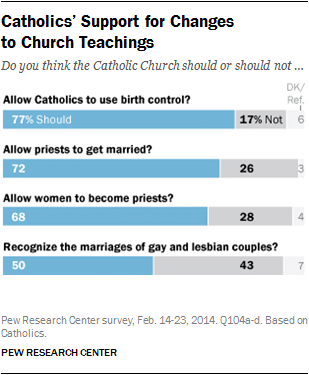
March 14, 2014 (HLI) – As a Catholic priest of nearly twenty-one years and president of an international pro-life organization, I am very concerned with the results of two recent surveys. By their nature, these types of surveys provide only a snapshot, and often hide an agenda, but I believe they both demand a closer look given the societal pressures on the Church and on the natural institution of the family.

Pew Research-Catholics Support Changes to Church TeachingsThe first survey is from the well-respected Pew Research Center, revealing that 77% of U.S. Catholics polled believe the Catholic Church should allow its members to use birth control, and that a majority believe the Church should allow its priests to marry (72%) and want to ordain women as priests (68%). The second was released by the German Bishops Conference, its data reflecting a response to a Vatican survey in preparation for the Synod on the Family in October. Though the survey revealed that German Catholics accepted and respected the Church’s teaching on stable marriages and family life, it also revealed an overwhelming rejection of the Church’s teaching on pre-marital relations, co-habitation, homosexuality and Communion for those who are remarried after divorce. According to the survey, Germans found the Church’s teaching on sexual morality “unrealistic and heartless.”  The bishops called the results “a sober inventory of what German Catholics appreciate about Church teaching on marriage and the family and what they find off-putting or unacceptable, either mostly or completely.”

If the results of these surveys accurately reflect the faithful of the Church — and let’s face it, they are not very surprising — then it is clear that the Church has failed to communicate the Faith and influence the culture. With skyrocketing rates of divorce and children born out of wedlock, with co-habitation becoming the norm rather than the exception, and with the ever-increasing acceptance among Catholics of same-sex unions, the Church is most certainly suffering a crisis in the rejection by the faithful of her teaching, leaving the faithful in the same brokenness and confusion as the rest of society.

Indeed, the smoke emanating from these surveys points to a raging fire being stoked by the rejection of God, the failure of catechesis concerning human sexuality and the sacrament of marriage, and concerning our nature as human persons made in God’s image called to be with Him for all eternity.

But also troubling is that we are now hearing calls even from within the Church to conform the “pastoral practice” of the Church to this confusion and desolation. As if it is the Church’s role to make those who are truly lost feel more comfortable in their sin and error, rather than offering them a voice of love in Truth, calling them back to God and His plan for their true happiness.

Creation_of_Adam_Michelangelo-2I want to ask those who are calling for the Church to reform her pastoral approach in the direction of accepting the unacceptable the following two questions: Is it not also true that most people have ignored or rejected the Church’s teaching on solidarity with the poor and the universal destination of goods? And if this is true (clearly it is), then should we not also set aside the Church’s social doctrine in favor of a more “pastoral” approach that avoids challenging the unjust structures that tolerate or exacerbate extreme, dehumanizing poverty?

Faithful Catholics who recognize the absurdity of these questions might be forgiven for wondering why the “pastoral” approach being proposed by some with regard to sexuality and marriage is even up for consideration, when the obvious consequences would be so grave.

At the heart of these debates over such serious and deeply intertwined social and moral issues is the false understanding of freedom. The secular understanding, as we know, is that freedom means being absolved from the natural consequences of one’s own actions. Regardless of what the surveys reveal, the Church must uphold true freedom — a person’s will that is formed in love and truth, and free to choose what is truly good — and proclaim it in every generation, in season and out of season, whether it is popular or unpopular.

The challenge before the Catholic Church in this current crisis, as always, is to speak with clarity to the transcendent nature of the human person. It is imperative for the Church to recognize where the faithful truly are on these issues, but in no way is it her job to simply make people feel better about their illusions, or to support ever greater State-sponsored programs to mitigate the logical social and economic consequences of these destructive errors.

Human nature, marriage and the family are not mere human constructs. We have been made by God, for God. Jesus reveals man to himself by taking him back to the very beginning — the origins of his creation — and reintroduces humanity to its Creator. The human person, more than a mere biological creature, is only truly free when faithful to his created nature.

Pope Francis in his Lenten Message says it so well: “If we think we don’t need God who reaches out to us through Christ, because we believe we can make do on our own, we are headed for a fall. God alone can truly save and free us.”

LEARN MORE:

http://www.lifesitenews.com/news/the-church-cannot-conform-her-pastoral-practice-to-the-dictates-of-the-worl

Outrageous: Ethicists Argue for Acceptance of “After-Birth Abortions”


Outrageous: ethicists argue for acceptance of “after-birth abortions”

According to two Australian ethicists, the baby in that photo should be killed if the parents so wish it, in what they call “after-birth abortion”. It’s not infanticide or murder to them. No, it’s just another form of abortion, because newborns aren’t really people yet. And while it sounds crazy and horrific, this unfortunately isn’t something I’m making up.

Alberto Giubilini with Monash University in Melbourne and Francesca Minerva at the Centre for Applied Philosophy and Public Ethics at the University of Melbourne write that in “circumstances occur[ing] after birth such that they would have justified abortion, what we call after-birth abortion should be permissible.”

The two are quick to note that they prefer the term “after-birth abortion“ as opposed to ”infanticide.” Why? Because it “[emphasizes] that the moral status of the individual killed is comparable with that of a fetus (on which ‘abortions’ in the traditional sense are performed) rather than to that of a child.” The authors also do not agree with the term euthanasia for this practice as the best interest of the person who would be killed is not necessarily the primary reason his or her life is being terminated. In other words, it may be in the parents’ best interest to terminate the life, not the newborns.

The circumstances, the authors state, where after-birth abortion should be considered acceptable include instances where the newborn would be putting the well-being of the family at risk, even if it had the potential for an “acceptable” life. The authors cite Downs Syndrome as an example, stating that while the quality of life of individuals with Downs is often reported as happy, “such children might be an unbearable burden on the family and on society as a whole, when the state economically provides for their care.”

This means a newborn whose family (or society) that could be socially, economically or psychologically burdened or damaged by the newborn should have the ability to seek out an after-birth abortion. They state that after-birth abortions are not preferable over early-term abortions of fetuses but should circumstances change with the family or the fetus in the womb, then they advocate that this option should be made available.

As if that wasn’t sickening enough, there’s also this little gem:

Merely being human is not in itself a reason for ascribing someone a right to life.

Let that sink in for a few minutes.

So if a baby is born with Down Syndrome, or another disability, then according to these two, a parent should be able to just kill it. Or let’s say that the mother decides that being a parent is just too stressful for her. She should be able to kill her baby then, too. Baby costs too much money? Yep, just kill it. All of these things are perfectly acceptable, because newborns aren’t real people yet. And as for adoption in any of these circumstances? Well, that could cause the mother emotional distress, so the answer would be… kill the baby! The fact that they see adoption as something that would cause a mother emotional distress but not the murder of their own child just shows how sick these two people are.

The sad thing is, that this point of view is inevitable once you start allowing people to define just what a human being actually is. If we don’t value all life, then does it really make a difference when we kill a baby? At this point, what difference does it make if the baby is inside the mother’s womb or outside of it?

And while it sounds incredible that anything like this would ever be allowed outside of speculation in a bioethics journal, keep in mind the horrors of partial birth abortion. Keep in mind that our own president voted in favor of infanticide. And the arguments that these ethicists are making are the exact same arguments that pro-abortion advocates make for abortion every day.

Pro-aborts would surely scoff at this as fear-mongering, but I’d be curious to know what their answer is to why it is acceptable to kill a baby one day before they are born, and unacceptable to kill them the next day after they’ve been born. When we fail to stand for life, this is the inevitable conclusion. First it’s just the unborn babies that it’s OK to kill. Then it’s the newborns, and then the “undesirables”. If pro-choice is all about the choice of the mother, with no protection given to the child whatsoever, then why should it really make a difference when she kills her child?

LEARN MORE:

http://liveactionnews.org/outrageous-ethicists-argue-for-acceptance-of-after-birth-abortions/

Is Planned Parenthood Pushing its Sex-Ed and Abortion Agenda in Your Children’s School?


Is Planned Parenthood Pushing its Sex-Ed and Abortion Agenda in Your Children’s School?

by Rita Diller | Washington, DC | LifeNews.com | 3/13/14 3:43 PM

Opinion

We hear almost weekly from anxious parents who want to know whether Planned Parenthood is in their children’s school. Some have already started making phone calls and sending letters to the school district to find out when they contact us. Others are at a loss where to start.

Here is a resource to help you find quick answers about the prevalence, source, and format of sex education in your geographical area.

Q. Where in the US have sex ed programs been implemented? Where in my state have sex ed programs been implemented?

A. Sometimes we need look no further than the website of the enemies of life and morality to find a wealth of information. After all, these entities receive obscene amounts of government and/or foundation funding in order to advance their agenda and track their progress.

plannedparenthood19bThe Sexuality Information and Education Council of the U.S.—a pro-abortion organization intricately intertwined with Planned Parenthood—maintains a website that it says “represents the most complete portrait ever assembled of sexuality education and abstinence-only-until-marriage programs in the United States.”

It also tracks funding streams, grantees, and funded programs. It identifies “examples of model programs, policies, and best practices being implemented in public schools across the country that provide more comprehensive approaches to sex education in schools. The Fiscal Year 2010 edition undertakes the enormous task of creating a portrait of comprehensive sexuality education and abstinence-only-until-marriage programs happening across the country and provides an unparalleled amount of information and includes profiles for all 50 states, the District of Columbia, Puerto Rico, the U.S. Virgin Islands, and the other U.S. territories,” according to the SIECUS website.

Keeping in mind that SIECUS is 100 percent behind repugnant “comprehensive” sex classes and vehemently fights abstinence until marriage, one may follow this link and click on any state to find a great deal of information about funding received and programs being taught in various school districts across the state. Keep in mind, also, that this information is current only as of 2010. However, it was in 2010 that huge streams of renewable funding opened up for “comprehensive sex education” through the federal government.

Be aware that the programs that are referenced here as viable abstinence programs are not strictly abstinence. They teach about contraception and most go far beyond that. The contraception portions of many contain demonstrations that would scandalize grown-ups. If a program leans more toward abstinence and traditional marriage, SIECUS will complain that it uses fear-mongering, information and statistics promoting the benefits of marriage, heterosexuality, and other such things that SIECUS considers dreadful, bigoted, hateful, and harmful.

At the college level, Planned Parenthood maintains a presence on college campuses through its VOX (Voices for Choice) clubs and programs. To find whether VOX is on your campus, simply search the Internet for the name of your university paired with “VOX.”

A word about SIECUS: SIECUS was launched in 1964 by the Kinsey Institute to teach the Kinsey philosophy of sex education in American schools. Dr. Mary Calderone, a former medical director at Planned Parenthood, was the first director of SIECUS.

Dr. Alfred Kinsey authored the “Kinsey Reports” in 1948 and 1953. These reports were the basis for a sexual revolution that promoted and sanctioned promiscuity, pornography, and homosexuality. Kinsey’s research was disproportionally based on surveys of prison inmates, sex offenders, and prostitutes.

Quoting Concerned Women of America’s report, A Nation Deceived:
“To obtain data about the sexual behavior of children, Dr. Kinsey worked with trained pedophiles who sexually abused hundreds of children (as young as two months) to prove to the world that infants, toddlers, and juveniles could enjoy sex pre-puberty with the help of an adult. Their sexual torture was recorded as pleasure.” Read more about SIECUS here.

Q. How does Planned Parenthood and its network get into schools?

A. Anti-abstinence, “sex positive” entities with a broad national reach, like SIECUS, Planned Parenthood, Advocates for Youth, Answer, ETR Associates, and the Campaign to Prevent Teen Pregnancy are instrumental in laying the groundwork to facilitate implementation of what the Planned Parenthood network refers to as “comprehensive sex education.”

Entities targeting regional areas to implement sex classes in schools recently revealed by STOPP include SHARE in Arizona, and WISE, now reaching into nine states.

SHARE: The Sexual Health and Responsibility Education initiative is the vehicle created by Planned Parenthood of Arizona to push its sex education programs into schools. According to the Planned Parenthood of Arizona (PPAZ) website, the Sexual Health and Responsibility Education initiative, or SHARE, is actively working to provide:

• Assistance with the selection of a comprehensive sexuality education curriculum that aligns with National Sexuality Education Standards-Core Content and Skills, K-12 [Read more about the National Sexuality Standards created by Planned Parenthood and cohorts here.]

• Resource support for teacher training

• Technical support-coaching and curriculum mapping

• Parent workshops

In fact, the job description for Planned Parenthood’s new community organizer/regional health coordinator in Yuma, Arizona, says that person, under the guidance of the PPAZ director of education “identifies target school districts and works with school leadership to move toward adoption of a comprehensive sexual health curriculum policy in these districts to advance the Sexual Health and Responsibility Education (SHARE) initiative.”

WISE: The Working to Institutionalize Sex Education initiative, with the goal of institutionalizing, or normalizing, the Planned Parenthood network’s repugnant, hedonistic “comprehensive” sex education, targets geographical areas with “favorable policy climates” for the normalization of sustainable school-based sex education. Current locations targeted by WISE include Washington; Oregon; California; Colorado; Iowa; Georgia; North Carolina; West Virginia; and Rochester, New York.

WISE works from the top down, beginning at the state education board level. By working at the state level, it is much easier to bypass parents in implementing laws that require or promote “comprehensive” sex classes in schools.

The Wednesday STOPP Report has covered the WISE initiative extensively. Read more about the far-reaching impact of WISE here.

Q. Who funds these blanket organizations pushing classroom sex education and legislation to require it?

A. SIECUS thanks “Anonymous Foundation, The Brico Fund, The Robert Sterling Clark Foundation, The Educational Foundation of America, and the WestWind Foundation” for funding its public policy and advocacy efforts, in its FY 2010 report.

According to the WISE initiative’s “method toolkit,” the initiative is “led by the Grove Foundation . . . [and] supported by a collaboration of funders including the Ford, William and Flora Hewlett, and David and Lucile Packard Foundations.”

SHARE is listed as an initiative of Planned Parenthood of Arizona. No funding source is identified.

Q. Who is teaching the PP curriculum? Teachers from districts or PP employees?

It varies from place to place. We know that Planned Parenthood of Arizona is training “facilitators to help teachers and other youth serving professionals develop the confidence they need to successfully deliver the curriculum to students.”

In Georgia, the lead WISE initiative partner GCAPP says,

The WISE Initiative services to school districts include: support in selecting sexual health curriculum, teacher training, parent workshops, and technical assistance as needed throughout the implementation process. Since 2009 GCAPP has trained 200 teachers in over 75 elementary, middle, and high schools to implement medically accurate, age appropriate curricula reaching over 17,000 students in the 2012-13 school year alone.

From the WISE toolkit website we learn:

In the first three years of the initiative, all of the WISE sites made significant progress toward their objectives. Collectively, over 100,000 students have been impacted due to WISE related activities; over 700 teachers have been trained; and 120 schools have implemented sex education where there was previously no sex education before or where it was significantly improved upon due to WISE.

Planned Parenthood keeps a low profile in the structure of WISE. However, looking down the ladder at the structure of the lead partners, Planned Parenthood comes clearly into focus. For instance, a WISE Iowa Project brochure lists Planned Parenthood as a partner. In Colorado, Planned Parenthood of the Rocky Mountains is an alliance member of Colorado Youth Matter, the organization that is leading the WISE initiative there. Similar connections between Planned Parenthood and WISE lead partners exist in other states receiving WISE initiative funding.

In Oregon, a list of WISE board members includes three Planned Parenthood employees. In California, one must dig a bit deeper to find Planned Parenthood’s involvement. There we find that ETR heads up the California WISE initiative. ETR began as the educational arm of Planned Parenthood of Santa Cruz. Former ETR marketing director Steve Bignell, editor of the Family Life Education curriculum and Family Life Educator magazine, served as education director at Planned Parenthood of Santa Cruz.

An educational venture presented by Planned Parenthood of the Great Northwest and endorsed by the Planned Parenthood Federation of America (PPFA), Planned Parenthood University offers “nationally recognized professional certification in reproductive health and sexuality education.” It awards a “Sexuality Education Certificate for educators, trainers, and outreach staff of Planned Parenthood affiliates and related organizations, providing sexuality and reproductive health presentations to groups in their communities and in schools and other educational settings.” The list goes on and on.

The bottom line is that Planned Parenthood participates, whether directly or indirectly, in many settings in teaching classroom sex classes, or in teaching others to teach sex classes in our schools. It is necessary to examine each location, and sometimes to dig very deeply into the structure of the program to determine Planned Parenthood’s involvement.

LifeNews.com Note: Rita Diller is the national director of American Life League’s Stop Planned Parenthood Project.

LEARN MORE:

http://www.lifenews.com/2014/03/13/is-planned-parenthood-pushing-its-sex-ed-and-abortion-agenda-in-your-childrens-school/

Sebelius Continues to Take the Dodge Regarding Abortion Coverage Lawlessness on ObamaCare Exchanges


Sebelius Continues to Take the Dodge Regarding Abortion Coverage Lawlessness on ObamaCare Exchanges

By Susan T. Muskett, J.D., Senior Legislative Counsel

Congressman Andy Harris

Congressman Andy Harris

Congressman Andy Harris (R-Md), a member of the House Appropriations Committee’s Subcommittee on Labor, Health and Human Services, today questioned HHS Secretary Kathleen Sebelius regarding two key aspects of abortion coverage on the ObamaCare Exchanges.

First, Congressman Harris questioned Secretary Sebelius regarding the difficulty that consumers are having in determining whether or not Exchange plans cover elective abortion. Even the CEO of Planned Parenthood Votes Northwest (PPVNW) recently wrote that “under the Affordable Care Act, it’s nearly impossible to find out which insurance plans cover abortion.” (An “Exchange” is a marketplace for the purchase of health insurance. ObamaCare requires an Exchange to be established in every state.)

This the third time that Secretary Sebelius has been questioned by a congressional committee on this very issue. Sebelius was questioned about it by the House Energy and Commerce Committee on October 30, and again on December 11, 2013 by the Health Subcommittee of the Energy and Commerce Committee. Today, Congressman Harris reminded Sebelius that she had told the Congress that all a consumer needed to do was to go to an ObamaCare plan’s “Summary of Benefits” to determine abortion coverage. (The ObamaCare law requires every Exchange plan that covers elective abortion to give notice to enrollees of that abortion coverage in the Summary of Benefits (PPACA Sec. 1303(b)(3)). Harris then held up the Summary of Benefits for every Exchange plan in the state of Maryland and he said that “none of them have an indication whether they cover abortion in the Summary of Benefits. It’s not transparent whatsover.” He asked Sebelius if she believed that abortion coverage should be transparent to the person visiting an Exchange website. In response, Sebelius said “I think it should be transparent, what all the benefits are” and “I understand, I think people should know what the benefits are.” To listen to her, an observer would think Secretary Sebelius was some kind of a bystander or onlooker to the Exchanges. But in later questioning by Harris, she conceded that HHS has supervisory authority over all of the Exchanges, including the state Exchanges. Yet, five months after this issue was first brought to Secretary Sebelius’ attention by a congressional committee, she apparently has still taken no action to resolve it.

Second, Harris questioned Sebelius about the ObamaCare statutory requirement that Exchange plans that cover elective abortion must collect a separate payment from enrollees for the abortion coverage (PPACA Sec. 1303(b)). As the staff of the Washington Post explained on page 180 of their book, “Landmark: The Inside Story of America’s New Health-Care Law and What It Means for Us All:”

“Insurers can include abortion coverage in plans offered in the exchanges. But everyone who buys a plan that includes abortion insurance – whether a woman or man, of any age – will have to make two separate premium payments: one covering the bulk of the policy and another far smaller one, as little as $1 per month, for abortion coverage. The thinking is that this will further help insurers keep private premiums and federal money separate.”

At today’s hearing, Harris pointed out to Sebelius that the Maryland Insurance Commissioner had said that Exchange plans don’t have to invoice separately for abortion coverage in plans that cover abortion. (Congressman Harris was referring to Bulletin 13-24 issued by the Maryland Insurance Commissioner to insurers over seven months ago on July 31, 2013). Sebelius tried to evade responsibility for what the Maryland Insurance Commissioner was doing, but under pointed questioning from Congressman Harris she conceded that she has supervisory authority over the Maryland exchange. (For more information on how the two separate payments statutory requirement is being ignored, see“Bait-and -Switch: The Obama Administration’s Flouting of Key Part of Nelson ‘Deal’ on ObamaCare” here.)

When will Secretary Sebelius quit taking the dodge regarding abortion coverage in the ObamaCare Exchanges when she comes before these congressional committees? The American people have waited for far too long for the answers that they deserve.

Abortion Insurance Opt-Out Law Brings Transparency for All, Peace of Mind for Many


Abortion Insurance Opt-Out law brings transparency for all, peace of mind for many


Editor’s note. This appeared on the blog of Right to Life of Michigan, NRLC’s state affiliate

Right to Life of Michigan President Barbara Listing

Right to Life of Michigan President Barbara Listing

A subtle yet significant change is happening in Michigan which will bring transparency to all and peace of mind to many with health insurance policies. On March 14, 2014, the Abortion Insurance Opt-Out law takes effect. This law was made possible by the dedicated prolife volunteers who collected signatures to initiate the legislation and Michigan legislators who voted to ensure no person is forced to fund the deliberate taking of an innocent human life in the name of health care.

So what will happen when the Abortion Insurance Opt-Out law takes effect on March 14? The sun will rise and Michigan will join 23 other states that have opted out of abortion being a standard part in health care policies offered through the national health care exchanges. Michigan will also join nine other states that have opted out of abortion as a standard part of private health care plans.

Right to Life of Michigan President Barbara Listing said, “Let’s be honest. Michigan citizens do not want to pay for someone else’s abortion with their tax dollars or insurance premiums. Michigan’s experience with Medicaid has clearly shown that tax funding for abortion leads to more abortions.”

The Abortion Insurance Opt-Out initiative has always been about who desires abortion coverage and who will pay for it; the law has nothing to do with the legality of abortion. With the Abortion Insurance Opt-Out law in place, both transparency and peace of mind is realized for those who have health insurance. After March 14, any health care policies purchased or renewed will not include abortion unless a separate rider is obtained. In addition, if an employer private plan includes an abortion rider; all employees must be informed of the rider’s provisions.

This change brings both transparency and peace of mind. Policy holders in Michigan will know whether or not their health insurance plan includes abortion.

Listing said, “Abortion is not true health care – abortion kills a living, developing human being. March 14 is a good day for Michigan.” http://feeds.feedburner.com/%7Er/RightToLifeOfMichigansBlog/%7E4/IOtcv3tJ59o?utm_source=feedburner&utm_medium=email

A Primer on How to Recognize a Cover Up of the Abortion-Breast Cancer Link (ABC Link)

A primer on how to recognize a cover up of the abortion-breast cancer link (ABC link)

By Joel Brind, Ph.D.

Joel Brind, Ph.D.

Joel Brind, Ph.D.

After researching and publishing on the ABC link for over 20 years, I’ve managed to get the hang of the formulaic manner in which studies come out periodically to “reassure” the public about the “safety” of abortion. Such studies often come out in the most prominent medical journals, coincidentally on the heels of studies that have reconfirmed the reality of the ABC link.

Why? To keep up the mainstream medical journals’ wall of denial.

But one needn’t be an epidemiologist to appreciate the way standard epidemiological (epi) methods are used inappropriately, so as to make the facts of the ABC link disappear. The techniques are remarkably few. With a few real life examples from the ABC literature, the lay person should be able to learn to spot these tricks rather easily.

Case-control studies

First, it is important to understand the two basic types of epi study. The most common is the case-control study. In a case-control study, a group of patients with the disease in question (e.g., breast cancer) is recruited, along with a group of women without cancer, but who are otherwise similar in age, ethnicity, and country (or smaller location) of residence. The latter group is the “control” group.

The researchers then query the women in the two groups, typically by having a trained nurse interviewer go over medical and reproductive history with them. Data is entered into a questionnaire that can be processed by a computer.

One of the reproductive history data is typically “number of induced abortions.” These data are often reduced to the dichotomous form–yes or no, a woman has had or hasn’t had an induced abortion.

(For comparison purposes, the baseline number for “relative risk” is “1″. If the number is over 1, there is an increased risk. For example, if the relative risk is 1.4, there is a 40% increased risk. If the relative risk is 0.7, there is a protective effect; a 30% reduced risk. In case-control studies, the actual statistic used to provide an estimate of relative risk is called the odds ratio—OR.)

When the data are tallied, if there are more women among the breast cancer patients who reported having had an induced abortion than there are among the cancer-free women, this “association” can be interpreted as increased risk, represented by OR>1 [more than 1).

Conversely, if more abortions are reported among the healthy women, an OR<1 would result [less than 1], and indicate that abortion lowers the risk. Of course, such associations do not prove cause-and-effect, but that gets established by the biology.

Most epi studies are case-control studies, and since most of them indicate an increased breast cancer risk for women who have had an abortion (i.e., that there is an ABC link), what are pro-abortion researchers to do?

Usually they first seek to discredit the methodology in such studies. They argue that such studies suffer from a flaw called “reporting bias” or “response bias.” How does that supposedly work?

They declare that women with breast cancer will be more honest about their abortion history. Thus if the same number of women without breast cancer as breast cancer patients have had an abortion—but the breast cancer patients are more “honest” and report more of their abortions–it will falsely appear that there is a “positive association,” i.e., an increased risk for breasts cancer associated with having an induced abortion.

The trouble with this response bias argument is that it has been amply disproven many times. One good example was a 1989 case-control study in upstate New York that was not based on after the fact interviews with patients v. healthy “control” women. Instead it was based on medical records from the time of the abortion.

That meant the record of who had and did not have an abortion was established long before anyone in the study got breast cancer. That study resulted in an OR of 1.9, i.e., a 90 increased risk associated with abortion.

Though published in a prominent epi journal, mainstream researchers often simply deny that such a study even exists!

But what about the relative minority of case-control studies that do not show an ABC link? Good examples of these are a large study on women from Shanghai, China, published in 2001 and a Serbian study published just last year.

In the Shanghai study population, no significant association with abortion was found (OR = 0.9). Note 66% of the women in the study had had at least one abortion.

In the Serbian study, there was actually reported a negative association (i.e., a protective effect, or reduced risk of breast cancer) with abortion (OR = 0.46). Note the prevalence of abortion among the study population was a whopping 89%.

Why does the high incidence of abortion in the population make a large difference in determining whether an ABC link exists?

As we explained in a letter published in the British Journal of Cancer in 2004, the high prevalence of abortion explained the effect. Essentially, epidemiology can identify exposures that are associated with a given disease, as long as those with the disease can be compared with typical members of the population who do not have the exposure in question.

However, when the majority of the population has had the exposure (in this case having had an abortion), the comparison group (those who did not have an abortion) is no longer typical. In the case of breast cancer, where most of the women have had an abortion, the women who have not had an abortion are generally those who’ve also had fewer children and who started having children at a later age.

But starting to have children when one is older and having fewer of them are both risk factors for breast cancer. The comparison group is really a high-risk group. Hence, the effect of abortion disappears when the majority of women are post-abortive.

And if the majority is overwhelming (like the 89% in the Serbian population), those who’ve had abortions actually show up with lower risk–that is, compared to the very small minority of sub-fertile, high-risk women who have not had any abortions.

This explanation was reiterated and expanded in the recent meta-analysis of 36 studies from China, published last year. The Chinese authors of that study also showed the clear trend of decreasing ABC link as the prevalence of abortion increased.

The bottom line is simple. If you are determined not to find a ABC link, just make sure you choose a study population in which most of the women are post-abortive. It also helps to restrict the study to women who’ve had at least one livebirth—as both the Shanghai and Serbian studies did. Why? Because childless post-abortive women have a higher breast cancer risk than women who’ve never been pregnant.

Cohort studies

But if your main argument against the ABC link is that case-control (i.e., retrospective) studies are unreliable because of response bias (whose repeated disproof has not dissuaded most mainstream pro-abortion researchers from its invocation), then the study you conduct needs to be of a type routinely championed to be methodologically superior. This second major type of epi study is called a cohort study (i.e., prospective).

In a cohort study, you start with a population wherein the fact of abortion is recorded at the time of the abortion, and all women are then followed in time to see who gets breast cancer and who does not. Because it’s not even possible for such studies to suffer from response bias, cohort studies are routinely touted by mainstream pro-abortion researchers to be superior to case-control studies.

They trotted out a number of them in very prominent journals between 1997 and 2008, to “prove” to the world that there was no real ABC link. (The reader might remember that in 1996, we published a worldwide meta-analysis that found a significant ABC link among all studies. Our meta-analysis garnered major mainstream attention and credibility to the ABC link–and that could not be allowed to stand.)

The first and the worst (and the largest) of these cohort studies was published in 1997 in the “New England Journal of Medicine,” arguably the most influential medical journal in the world. The study was based on the medical records of all 1.5 million women born in Denmark between 1935 and 1978, including over 400,000 abortions and over 10,000 cases of breast cancer.

The Danish study was widely touted as disproving the ABC link. It found a relative risk of 1.0; there was no possibility of response bias; and the statistical sample was enormous.

As I have written before, the flaws of the Danish study are many and monstrous. However, the most important flaw concerns the question of follow-up time. (Bear in mind breast cancer takes years to develop.)

In a case-control study, one typically starts with older women–since they are cancer patients–and so they are mostly diagnosed many years after the abortion has taken place. This makes sense, because it takes about 8-10 years for cancer to develop after an exposure like abortion.

But suppose you design your cohort study such that you log both abortions and breast cancer diagnoses during the same time period. That’s what the Danish study and several influential cohort studies did. So, for example, in the Danish study, both abortions and breast cancer diagnoses were collected through 1992.

Remember that the study included all women born through 1978—i.e, including women as young as 14. So a teenager in Denmark who had an abortion in 1992 is included in the study as a woman who had an abortion but did not develop breast cancer.

Well of course not—breast cancer takes years to develop! So in fact, the Danish study included a total of 358,000 women under the age of 25—fully one fourth of the study population, who collectively had over 100,000 abortions—yet represented a total of only 8 cases of breast cancer!

So that’s how one stacks the deck of a cohort study with women who have abortions, but no breast cancer: allow for as little as zero follow-up time after the abortion. And to make sure the ABC link does not show up, it’s also important to eliminate the type of breast cancer that shows up most quickly following an abortion, so called “in situ” carcinoma. Typically, the cohort studies that do not show an ABC link simply eliminate in situ carcinoma diagnoses from the study.

Now you know the basic tricks for conducting an ABC link study—whether retrospective (case-control) or prospective (cohort) in design—that does not show the link. Watch for them.

Editor’s note. Joel Brind, Ph.D. is a Professor of Human Biology and Endocrinology at Baruch College, City University of New York; Co-founder of the Breast Cancer Prevention Institute, Somerville, NJ; and a frequent contributor to NRL News and NRL NewsToday.

She’s WHAT? Unexpectedly Pregnant at 42


She’s WHAT? Unexpectedly Pregnant at 42


By Dave Andrusko

Leslie Leyland Fields wrote a magnificent book about women finding out they are unexpectedly pregnant.

Leslie Leyland Fields wrote a magnificent book about women finding out they are unexpectedly pregnant.

The title of the deeply personal reflection at http://www.parenting.com is, “I’m What? Accidentally pregnant at 42, I faced the hardest decision of my life.”

This hit home for two reasons. My own mom, rest her soul, delivered my youngest brother when she was 40. My dad, an over-the-road truck driver, was gone and I drove mom to the hospital. To this day the experience remains as vivid as if it happened yesterday: while she was delivering James, I worked on a paper for a writing class my freshman year in college!

The other reason is that two of the most pro-life women I know have told me how conflicted they were (to put it politely), torn (to be more candid) when they found out they were pregnant at 39 and 41 years old, respectively. As I often tell my “pro-choice” friends who insist pro-lifers live in some parallel universe free of struggles and difficulties, we are just human beings, too. It’s what you do with them.

We know from first-hand experience there are many, many instances where a pregnancy seems terribly ill-timed. We know the fear that a woman experiences, including the apprehension that she couldn’t be a “good mother” at that stage of her life. (Dads can—and do–feel exactly the same sense of inadequacy.) That is a perfectly understandably reaction.

The story by “Nancy” does a wonderful job conveying the emotional ups and downs. She and her husband had adopted two children after their attempts to have their own biological children fail, and then, wham!

Click here to read the February/March issue of National Right to Life News,
the “pro-life newspaper of record.”

And even though 42 years old, she tells us her first response was denial summarized in four words.

“This cannot be happening.”

You look for clues in the narrative to figure out why Nancy reaches the decision she does. It’s off to an ominous start—the understandable worries about her age, her bouts of morning sickness, her sense that she’s never really been into little babies, that this is SIMPLY TOO MUCH.

Nancy describes herself as a religious person who

“believes that God has a plan, and it usually works out if we just ride with it. In rare moments I can imagine this will all be okay, that I’ll be able to handle three children and even like it. But most of the time I want to scream, What kind of sick joke is God playing on me? I’m a weary mother of two with a high-pressure job and a house that’s falling apart! I can’t raise another child.”

She wakes her husband up at three in the morning to discuss abortion.

“We talk for two hours, and the next morning we both feel relieved. Abortion, as awful as it is, feels like the right thing to do. Neither of us wants another child or feels equipped to deal with one, let alone what would be our first infant. More important, we both feel we have our family — these two girls are our babies, and we will never love anyone more. A biological child feels like an intrusion, a strange add-on to a beautiful family. The window of opportunity for more children is gone. We’re done.”

But she decides she has to know what she is getting herself into. “If I’m going to have an abortion, I have to learn something from the experience. I can’t just look at this pregnancy as a mistake,” a very revealing remark. Nancy tells friends who she believes will support her decision [!] and finds that a surprising number have had abortions. While they do not say “don’t,” they are not cheerleaders on behalf of abortion, either.

What strikes you is how true to life this is—how so much of what Nancy feels reflects how good or bad she feels that particular day. After she has wrestles with going in for a “termination consultation,” she says

“I’m only 75 percent sure about my decision. The other 25 percent is terrified that I’ll never forgive myself for giving the baby up, that I’ll always wonder what it would have been like. I pray for some kind of resolution. I just want a sign. We need to move on.”

Don’t know if it qualifies as a “sign,” but as she walks her oldest daughter to kindergarten she realizes she feels better even though the nausea remains strong in the morning. “I think about another child and feel that the possibility might be there,” she writes. “After I drop her off, I end up walking all the way to work — a good 40 minutes — just to prolong the good vibe.”

The pivot in many ways may be that because of the conflicting emotions, she has put off her “termination consultation.” And the baby that four weeks before “looked like a grain of rice,” now (she is shocked to see) “has arms and a head.”

Nancy tells us, “I walk out into the sunshine and realize I’m having another child.”

The conclusion will tear you up, at least it did me.

“A week later I’m sorting through summer clothes and packing some up for charity. Roma keeps taking things out of the giveaway bag, and I get annoyed. ‘But Mom,’ she says, ‘We need to save these for the baby.’ John and I haven’t said a word to her, but she already knows.

“Everything is going to be okay. More than okay. Blessed? I think so.”

Please join those who are following me on Twitter at twitter.com/daveha. Send your comments to daveandrusko@gmail.com.

They are Desperate to Save Obamacare

Susan B. Anthony List

Hi Pro-life Friend —

Just in case you weren’t convinced that Obamacare is the largest expansion of abortion on-demand since Roe v. Wade, just take a look at who its biggest cheerleader is: Planned Parenthood.

Just yesterday, Planned Parenthood announced it would spend millions of dollars to pay canvassers to knock on 20,000 doors per day and hold over 500 events over the next 3 weeks alone to enroll as many new people in Obamacare as possible.

For Planned Parenthood, it’s a simple equation:

More Obamacare Enrollees = More Planned Parenthood Clients = More Planned Parenthood Abortions = More Planned Parenthood Profits

Planned Parenthood knows that an early investment in the success of Obamacare will pay massive dividends in the long run as it creates a whole new pool of clients with abortion coverage subsidized by YOU and me.

>>> Help us fight back: Contribute $10, $25, $75 or more right now to the SBA List’s aggressive plan to kick Harry Reid out of power this November so we STOP Obamacare and Planned Parenthood. Planned Parenthood knows that the roll-out of Obamacare has been an utter disaster, so they are doing everything they can to save it…especially as we head toward this November’s elections.

As you know, the pro-life House of Representatives has voted to repeal Obamacare, end taxpayer funding of abortion and abortion providers, end sex-selection abortion, and end gruesome late abortions.

And one of the biggest roadblocks to enacting this pro-life legislation can be moved this November with your help: The Senate’s pro-abortion majority led by Harry Reid.

>>> Fund the SBA List’s aggressive plan for Pro-Life Victory this November by making the most generous donation you can right now.

Remember, Planned Parenthood knows the stakes.

…That’s why they plan to spend over $18 MILLION this election cycle to protect their pro-abortion Senate Majority.

We simply cannot fight back without your continued support.

The SBA List knows how to win elections, and we spend every dollar you contribute toward these efforts wisely.

So please, Pro-life Friend, don’t let Planned Parenthood get their way… please chip in today.

For Life,

Marjorie Dannenfelser
President, Susan B. Anthony List

PS: Pro-life Friend, Planned Parenthood is going all out to enroll as many people into Obamacare as possible and protect their pro-abortion majority in the U.S. Senate. Please, go “all out” today by making the biggest gift you can to fund our 2014 campaign plan. We need to defeat these abortion extremists and can only do it with YOUR help.

Donate Now